
Disabled young musicians gain valuable ensemble experience at Royal Birmingham Conservatoire23/7/2024
 Young people with an upper limb weakness, difference or absence are being offered the opportunity to join ensembles with the next generation of music teachers, thanks to a pioneering new partnership between Royal Birmingham Conservatoire (RBC) and The OHMI Trust. The project, which started as a trial in January, was conceived with the aim of creating an environment where disabled individuals with their adapted musical instruments and enabling equipment, could join able-bodied peers to perform together. Participants, aged between 10 and 19 years, are offered ten sessions over the year which might be blocks or spread over months. Performance opportunities, most recently at Symphony Hall in Birmingham, highlight the potential for adapted musical instruments to perform in recognisable ensembles such as quartets and trios. The collaboration is particularly important in raising awareness of inclusive music-making amongst the next generation of music teachers who are currently RBC students. Such ‘playing buddies’ include Katie Jordan on woodwind, Rachel Cocks on trombone and Charlotte Clews on flute. Reflecting on her role in the project, Katie said: “I’ve found the process really helpful. I’ve not got a lot of one-to-one teaching experience and these sessions have definitely helped me build the confidence to be able to teach more students. It’s also fascinating to see the different challenges that come with the one-handed flute as opposed to the standard flute. The one-handed instrument is very tricky for me to play after learning on a regular flute.” OHMI Music-Maker Husna added: “I’m a lot more confident now. In the last year, OHMI have provided me with two fantastic opportunities to showcase the skills I’ve learnt – a solo performance at the music festival for Music-Makers at Barton-Under-Needwood and I’ll also be playing at Symphony Hall. Without the support from OHMI I feel that wouldn’t be possible.” The project has been made possible thanks to support from DMF Ellis Charitable Trust and the Grantham Yorke Trust. Given the success of the project to date, it is hoped that funding will be found to extend the project next year. Students seeking to get involved can register their interest by contacting Faye Oakland, OHMI Music-Makers Manager at: [email protected]. Unfortunately, Katie wasn't able to perform at Symphony Hall but we are grateful for Craig Holmes from Services for Education stepping in. You can watch their performance here: Call for papers and presentation ideas issued for OHMI’s Music & Physical Disability Conference 20257/6/2024
 Valerie Thomforde at the 2018 OHMI Conference, testing out a violin adaptation created by Lia Mice A call for papers and presentation ideas has been issued to help deliver a major conference on Music & Physical Disability taking place in Birmingham on 15th and 16th March 2025. The conference, which is being delivered by the OHMI Trust, in collaboration with Birmingham City University and Imperial College London, will explore the music-making barriers faced by people with physical disabilities, from the design and ongoing production of instruments to wide-ranging issues around performing. The event aims to bring together perspectives and experiences from a wide range of people including disabled musicians and instrument makers, as well as academic researchers from many different disciplines, teachers, charities, funders, and government agencies. Recently developed instrument designs will also be demonstrated.
The event builds on the success of the inaugural OHMI Conference in 2018 which attracted international representation and speakers from five continents. Rachel Wolffsohn, OHMI’s General Manager, said, “By sharing knowledge in this way at such a high-profile conference, we hope to stimulate further and more rapid developments over the coming years. We would like to encourage presentations or presentation ideas from anyone who understands and is interested in this important area of work. “We are looking for submissions that might relate to specific instruments, teaching, performance or learning. They might be early experiences with music, and their consequences, or challenges of relearning an instrument after acquiring a disability – and everything else in between.” The deadline for papers is 30th September 2024. The winners of the OHMI Competition awards will also be announced at the event. Further information is available on the OHMI Research Partnership website: https://www.ohmirp.org.uk/ohmiconference.html  Musicians with an upper limb weakness, absence or impairment are being invited to join a new Music-Makers club. The club is being set up by The OHMI Trust and is designed to bring together adults who use adapted musical instruments or enabling equipment as well as parents of children who use such instruments and their teachers.
The aim of the OHMI Music-Makers club is to enable disabled musicians to share their successes and challenges and become part of a much bigger and growing community. It is free to join and members will receive:
Rachel Wolffsohn, General Manager at OHMI, explains, “We know playing an adapted instrument can often be a lonely experience, particularly for children when they might be the only person in their school who plays an adapted instrument. We decided to launch the group for the benefit of children who are having OHMI music lessons and for our instrument hirers but anyone who plays an adapted instrument is invited to join. “We have very many talented musicians who are part of the OHMI community. The new club presents the opportunity for them to celebrate achievements and share their experiences of instruments and equipment with others who are learning at the same time.”
 OHMI's Rachel Wolffsohn (centre) being presented with Barton Music Makers latest cheque in December We’d like to offer our sincere thanks to our generous-hearted friends at Barton Music Makers for their continued support of OHMI.
The charitable group, which was established in 2014, is based in Barton-under-Needwood in East Staffordshire. Alongside a community choir known as The Bar-Tones, the group holds musical events to raise funds for charity. OHMI has been chosen as a recipient of support on a number of occasions now and these sterling efforts have raised over £7,000. Most recently, £1,200 was raised which will allow us to purchase four tenor horn stands. Dr Stephen Taylor, Founder of Barton Music Makers and Choir Leader said "We are delighted to have supported OHMI for several years as our designated charity. From our perspective, it 'ticks all the boxes' in that it is based in The Midlands, helps the young and provides individuals with physical impairments an opportunity both to learn adapted instruments and to take an active role in and enjoy musical performance. “It has also been wonderful to welcome young musicians from OHMI to entertain our concert audiences. This is not only encouraging for the musicians but also helps to promote the charity to individuals who were, before then, unaware of its existence. We are very keen to help promote the brilliant work of OHMI whenever and however we can.” The group offers its support in other ways too and we’re delighted to say that its performances have involved several of our OHMI Music-Makers. Learn more about Barton Music Makers.
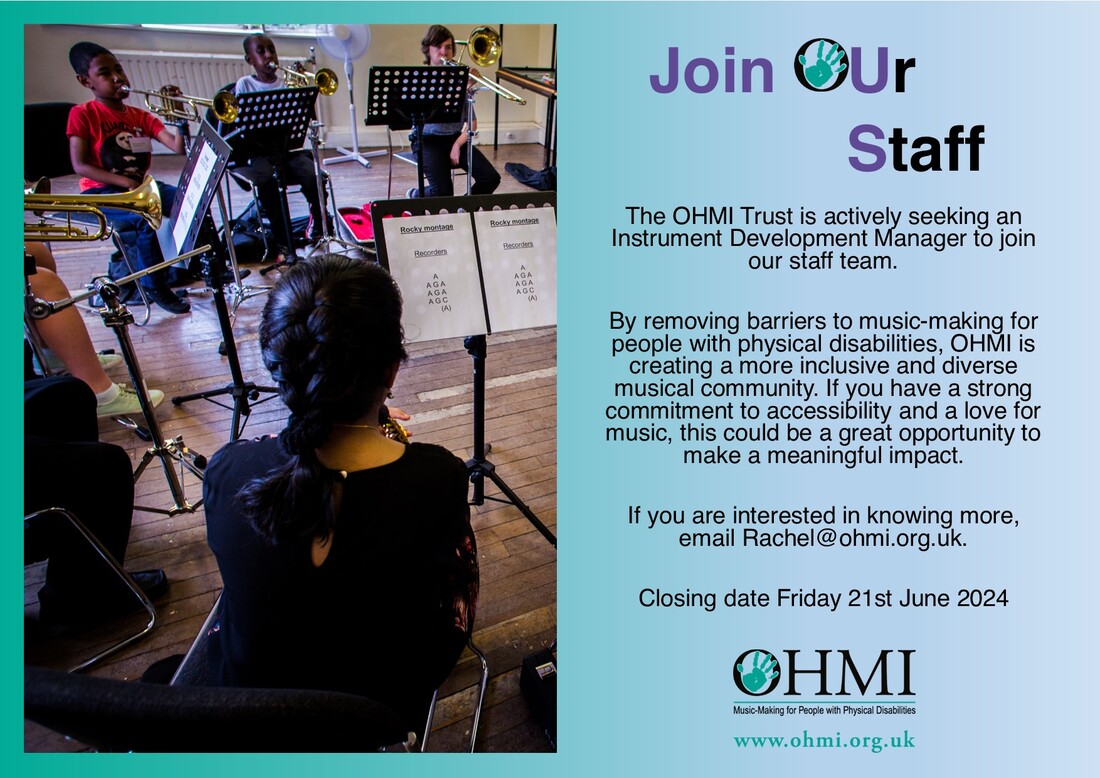
We are very excited to announce opportunities to join us at The OHMI Trust with these two roles: First is a new role - that of Instrument Development Manager. Instruments have always been key to the work of OHMI. If an instrument allows an individual to play what they want to play, when and where they choose, then this is a vital step in participating fully in music-making. Instruments come from a broad range of sources, and this role will be pivotal in ensuring that the pipeline of development is maximised for the future. For full details please download the details below.: 
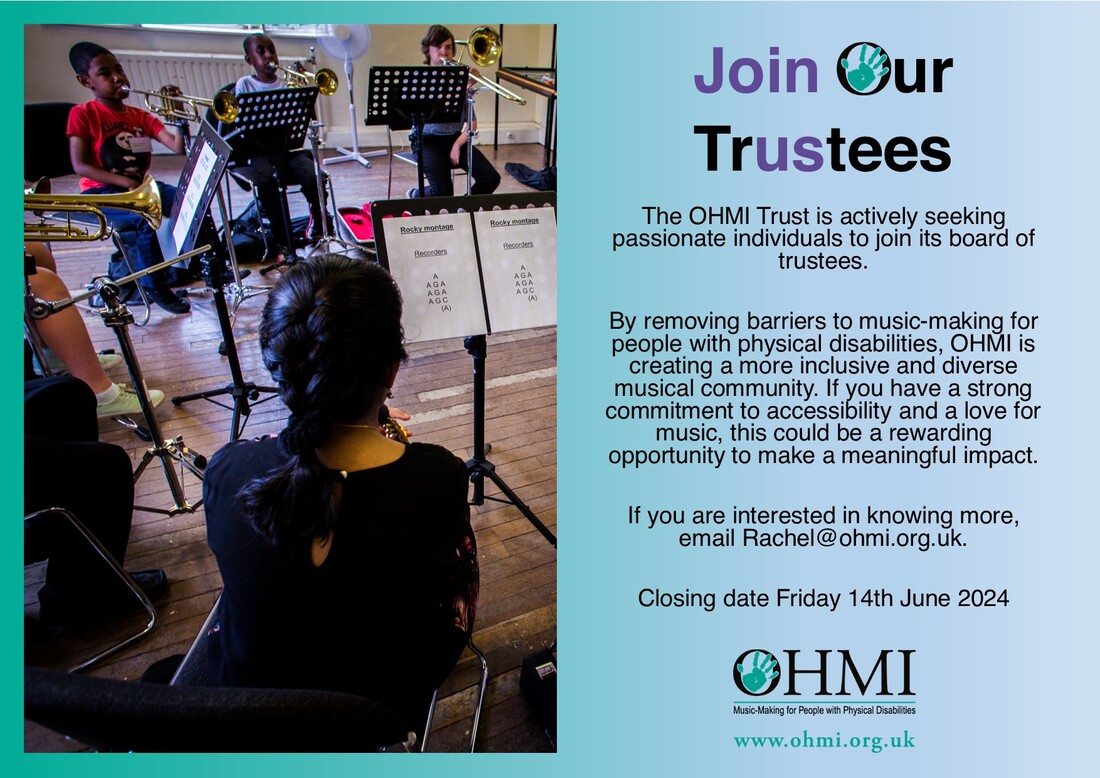
Second, there is an opportunity to join the wonderful team of Trustees that currently oversee the work of OHMI. This is a very important voluntary role at the Trust. At the current time we are particularly keen to recruit people with financial experience or fundraising knowledge. For full details please see the details below:
If you have questions about either role please email OHMI's General Manager for more information.
Please do share these opportunities with your contacts and networks too! |
CategoriesArchives
June 2024
|
||||||||
 RSS Feed
