
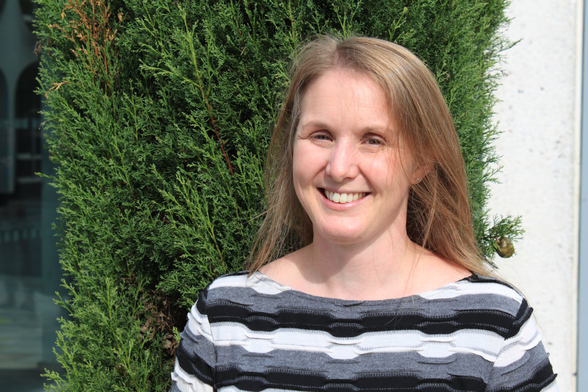
 Faye Oakland OHMI has announced the appointment of its new Music-Makers Manager, Faye Oakland. The appointment signals a new stage in OHMI’s relationship with music hubs across the country, enabling it to work with many more to bring adapted musical instruments and enabling equipment to more disabled children.
The Music-Makers programme is supported by a number of funders, including Arts Council England, the Paul Hamlyn Foundation and a number of smaller organisations. There are two elements to the programme: support of individual music-makers which is currently offered in Surrey, Herefordshire and Birmingham; and support of whole class ensemble teaching in Nottingham, Northamptonshire and Birmingham. The new Music-Makers Manager role will play a vital part in raising the profile of OHMI, and passing on its skills and knowledge to the music hubs so that their teachers feel empowered to identify specific needs of disabled pupils and match them to the most appropriate solutions. Rachel Wolffsohn, OHMI’s General Manager, said, “There are many occasions where the solution identified as part of a pupil assessment is a pretty straightforward one such as a trumpet or trombone stand to allow a child to play a brass instrument one-handed. Faye’s appointment means we can pour more resources into educating music teachers on such immediate solutions they have at their disposal. This in turn frees up OHMI’s time, not only to engage with a greater number of music hubs across the country but also to point our expertise to children with more complex needs such as where their disability prevents them from reaching all the valves of a trumpet and the solution, therefore, might be a pocket trumpet.” Faye Oakland, OHMI Music-Makers Manager, adds, “From my earlier experiences of working with OHMI when I was a senior leader at the Nottingham Music Hub, it was clear that nothing stands in the charity’s way when it comes to making sure a disable child can participate fully in class. My role as OHMI Music-Makers Manager is to make sure that there are solutions in place for a disabled child ahead of the September return to school so that there are no awkward first sessions where a music teacher is unaware of a child’s needs until they meet them and then are scrambling around for a quick solution. “It may take some years yet but we want it to become an entirely natural process that a disabled child’s needs are assessed ahead of time and that their chance to make music is no longer considered an afterthought.” Read more about Faye here. Learn more about OHMI Music Makers at: www.ohmi.org.uk/teaching 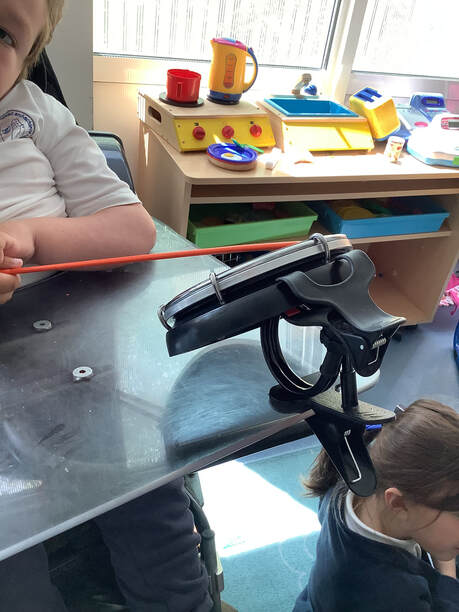 Children who might otherwise be excluded from music lessons are being given new opportunities to participate, following the launch of OHMI’s innovative new teaching programme.
Its introductory course on music-making for children with physical disabilities took place in April, and was delivered in partnership with Birmingham City University. It included demonstrations of the instruments and enabling equipment available to help children with physical disabilities to play music. Andrew Hird, Partnership Manager at Lincolnshire Music Service, was one of the practitioners who joined the training. As the Equity, Diversity and Inclusions (EDI) Lead for his Music Service, he has a keen interest in, and understanding of, what is needed to realise the ambitions outlined in new Government policy The power to change lives: a national plan for music education and ensure true for inclusivity across the 360+ primary, secondary and special schools across Lincolnshire. Integral to achieving these aims is the partnership between Lincolnshire Music Service and The OHMI Trust, with Andrew and a fellow member of the leadership team, Heather, both now trained to carry out needs assessments as a result of participating in OHMI’s training programme. Reflecting on the training, Andrew said, “The training was a real eye-opener when it came to assessing both physical disability and neurodiversity needs. “With the help of OHMI, we’re able to better assess needs and source appropriate solutions. We’ve secured a specially adapted Violin bow through Project Limitless – Prosthetics for Children | Koalaa to support the prosthetic of a girl with an upper limb absence. We’ve also provided a plectrum enabling a child with cerebral palsy to strum the Ukulele. I’ve also learnt that simply introducing a trumpet stand might help to anchor a child with ADHD.” “It is SO important that children with additional needs are not squirrelled away to work on other activities whilst their peers get to make music! It’s my job now to make sure that every partnership manager and the wider staff at the Lincolnshire Music Service are aware of all the resources they have at their disposal to make music truly accessible for all. Our assessments are ideally an in-depth 30-minute interview but even a snatched conversation walking at pace with a music teacher down a school corridor, goes some way towards identifying those children who need additional support.” Testament to the music service’s diligence in ensuring every child has the opportunity to play music, is the feedback from some of the pupils who have benefitted. Year 3 pupil Harrison has spinal muscular atrophy, a condition which limits his strength and range of movement. An initial assessment, carried out with the support of OHMI’s General Manager, Rachel Wolffsohn, led to sourcing a specially weighted, larger drum and wheelchair clip to enable Harrison to participate in Samba class. As Harrison points out, “Having the stands means I can do the music myself and not need a grown up to help me.” Rachel Wolffsohn, OHMI’s General Manager, adds, “OHMI has created a framework including games to assess a child's ability to bear weight, and explore their fine and gross motor skills and breath control. We can then source the appropriate instrument or adapted equipment for the child in question. “I’m delighted that Andrew is already putting his learning into practice. It’s vital that staff within the music hubs are able to fully assess what’s needed for children with additional needs, and make the schools aware that practical support is available.” “What is also critical is that any assessment happens months in advance of whole-class music lessons. Our Instrument Hire Scheme has grown to include more than 300 instruments and enabling equipment but they are highly sought-after, and we often come across a child whose unique needs mean we’re required to find something new. Many of the team at OHMI have lived experience as music teachers so we’re well-versed in finding those creative solutions. We just need to raise awareness within schools and music hubs that we have the means to do so.” OHMI’s next one-day training course will take place on 5 December 2023 in Birmingham. Please sign up here. 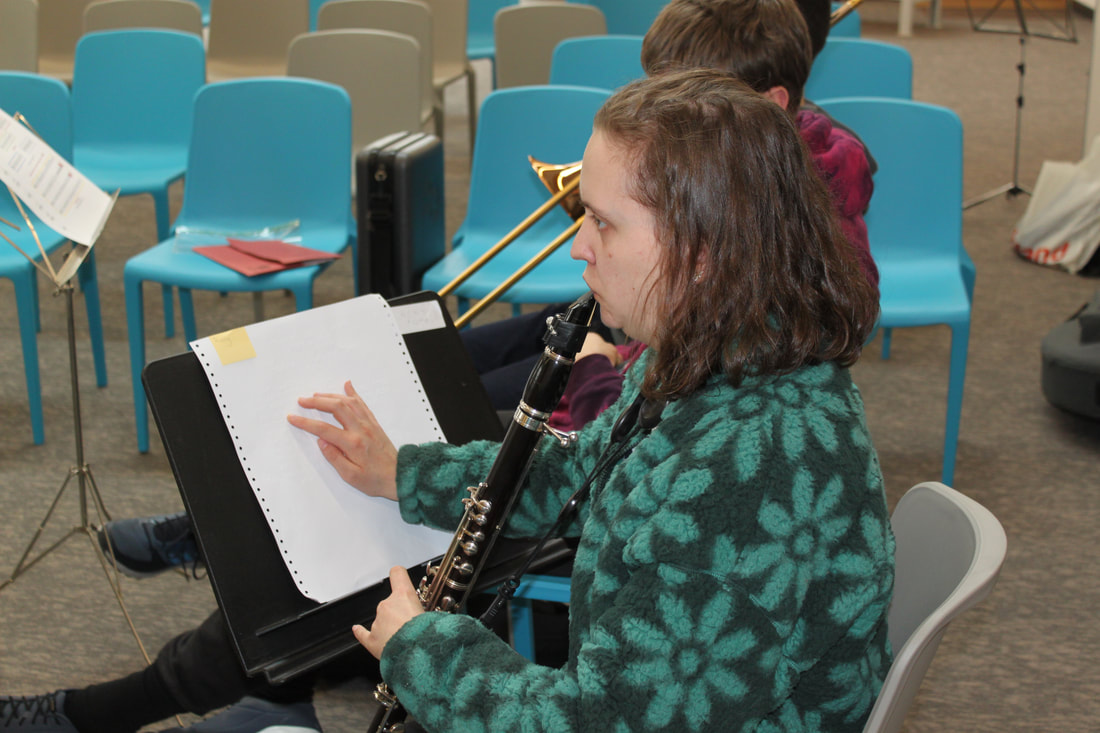 OHMI may well be specialists in one-handed musical instruments but the community of musicians we support who choose to play with a one-handed instrument, extends beyond those who have an upper limb weakness, difference or absence. One such example is Rowan, a visually-impaired (VI) musician who has chosen, rather than memorising her music, to play one-handed clarinet because it offers her opportunity to read Braille music at the same time as performing.
Supporting Rowan in her quest to source accessible music has been a key project for OHMI over recent years. We thought it would be interesting to report on what we have discovered. Rowan wanted to play music socially so choosing a wind instrument was a good choice for her [[VI musicians play almost every other instrument, so wind instrument is not "obvious"]]. She was our first OHMI Music-Maker to play the one-handed clarinet and is a member of National Orchestra for ALL (NOFA), the only non-auditioned, inclusive national youth orchestra in the UK, which includes some 100 young musicians. Often blind or visually impaired musicians learn music by hearing a music teacher play and then repeating it. Braille music, large print and talking scores give the musician independence to learn their own music, and really supports those instances where every note is important. But most musicians who use Braille music and play an instrument have to memorise every note they play, learning the piece in advance of performance. Rather than doing this, as an accomplished Braille reader Rowan instead chose to play one-handed and to read Braille music with her other hand, thus bypassing the need to memorise everything before playing. Together with Rowan and her family, NOFA and the RNIB we have been seeking to find the most pragmatic solution to sourcing Braille music for the performances of VI musicians. RNIB music library and transcription service A pragmatic starting point was the RNIB itself. RNIB's music library holds one of the largest collections of accessible format music for blind and partially sighted musicians. However, there is a huge disparity when it comes to availability of music for different musical instruments. Whilst there is a wide selection for pianists, there is, however, little for clarinettists. The key reason for this is that not many VI musicians play the clarinet therefore it is unusual for a clarinettist to use, and therefore request, Braille music. Braille music, per se, can be considered low incidence, high need. In the case of ensembles and orchestras where teachers and composers are creating their own arrangements, there is a requirement to create accessible versions of the bespoke music scores. Such music scores would be readily available for other musicians so why should this not be the norm for blind and visually impaired musicians? The main route to getting music transcribed has, until this point, been The RNIB transcription service. This transcription service, which is free to individuals, offers accessible sheet music (Modified Stave Notation) and braille music scores. Braille music is based on the same six dots as traditional braille letters but the meaning of the braille characters is redefined to represent musical signs instead of traditional letters. So there is each note, key, tempo and duration, as well as all the other musical signs you would expect in a score such as dynamics, ornaments, articulations and so on. There are, however, significant barriers to getting hold of Braille music. Firstly, RNIB’s transcription service is in high demand and, as such, there is a large backlog of requests. Secondly, Braille transcription can be a time-consuming process which means musicians have to submit their requests well in advance. Rowan’s mum, Beth, comments, “The first time we used the RNIB transcription service, the Braille music was produced by Golden Chord on a Perkins Brailler Writer. This piece of equipment has been used globally since it was invented in the 1950s but it proves to be painstaking work. Rather like an old-fashioned typewriter, the operator has to start again if they make a mistake. Even Tippex isn’t an option since it creates a bump on the sheet which may be confused with a Braille symbol. “We’ve accepted that it takes longer to get Braille music and, therefore, you simply need to be more organised – typically, six months in advance.” Automated braille transcription softwareAs with many other solutions for OHMI musicians, technology plays a key part. OHMI called upon the extensive knowledge of RNIB’s Braille Technical Officer, James Bowden, to suggest other routes, which mainly mean using a willing volunteer and/or automated braille transcription software. James outlines a number of automated braille music transcription options which, as he puts it, means you can have a braille music score “with you and your instrument within ten minutes which makes it a real-time pleasure!” It may not be absolutely perfect and often some refinement is needed, but it's a huge boost. Braille music transcription software includes:
The common theme to these solutions is that MusicXML is used as the input to Braille music translators. This is a format that can be output from most mainstream music notation software, including Sibelius, Finale and MuseScore. The basic process is as follows:
The process appears, at first glance, a relatively simple one but the devil is in the detail! Accurate notation is absolutely crucial for the braille to be accurate. For example, a symbol that is dragged from one place to another on the print score retains its original position on the braille score. The person creating the print score needs to know a fresh sign needs to be included every time if unexpected errors in braille are to be avoided. There is still some way to go in removing barriers for visually impaired children and adults who wish to play music, not only in terms of software developments and raising awareness amongst music teachers but also ensuring the same robust processes are in place as non-disabled musicians might enjoy, for example ensuring that ensemble music is included in certain tuition books. Collaboration and a collective desire to continue to improve the experiences of VI musicians is surely the key. You can read more about Rowan’s journey: OHMI’s first music-maker to learn the one-handed clarinet. Further reading
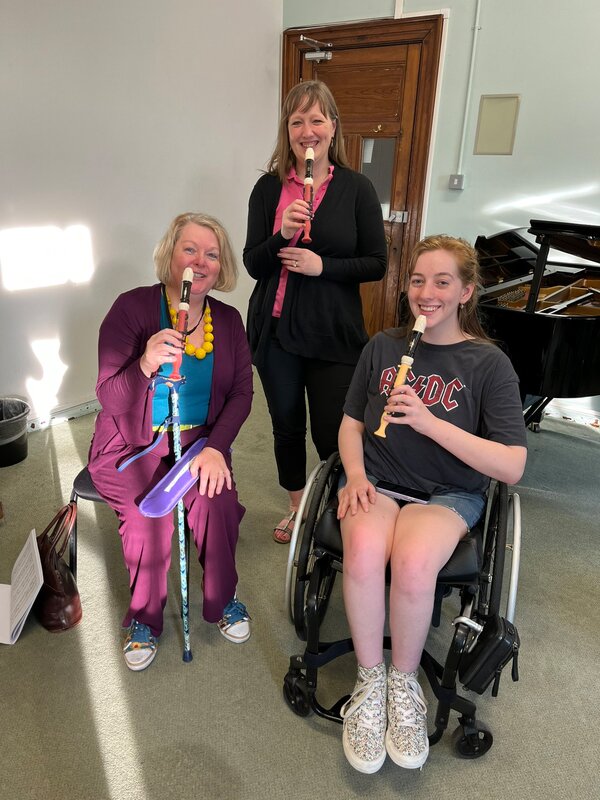 Our 3D-printed one-handed recorders were put to the test recently when Sarah Jeffery, one of the world’s foremost promoters of the instrument who performs in festivals and on stages across the world, accepted our invitation to play the instrument.
Sarah is an advocate for sharing her passion and expertise for the instrument, and posts weekly instructional tutorials on her YouTube channel, Team Recorder, which is followed by an audience of some 190,000 subscribers. After receiving an introduction to both the left- and right-handed recorders from OHMI General Manager Rachel Wolffsohn, and OHMI trustee and clarinet teacher, Clare Salters, Sarah dedicated one of her online tutorials to demonstrating the instrument. Her walk-through included the explanation that, on a one-handed instrument, the lower fingerings from C to G are the same, as are the higher octave keys from E to G. A system of keys is deployed to reach the higher notes, with the accidentals being a combination of the holes in keys. The 3D-printed one-handed recorder has been made possible through a collaboration between OHMI and musical instrument creator, Peter Worrell, with funding granted by Arts Council England. It is not the first time Sarah has played one of Peter’s one-handed recorders. She had the opportunity to play the wooden version with gold keys. Whilst she considered the instrument to be wholly beautiful, the plastic 3D-printed version is significantly more affordable. The one-handed wooden descant recorder retails at around £740 compared to £220 for the 3D-printed version. Both versions are available from OHMI for a rental fee from £50 per year, excluding shipping. Creating a more affordable version will allow more musicians to be reached, young and old. As Sarah points out, “One aspect I think is REALLY important is making sure all children have access to, and are included in, music education. So, if you are a record teacher, for example teaching whole class groups and you know that one of your children will benefit from a one-handed recorder, then do enquire about renting one from OHMI to make sure that child is included. It’s really rubbish that your whole class goes and does something and you have to wait it out, or you’re given something different to do. You want to be included right from the start." “It also keeps music accessible for those who may have had an injury, a stroke, arthritis, or something else that affects their mobility.” We’d like to extend our thanks to Sarah for taking the time to produce her tutorial, and for including the recorder journeys of other members of the OHMI recorder community, including Rowan who is an OHMI Music-Maker, stroke survivor Gareth Churchill and OHMI trustee, Dr Matthew Wright. You can watch Sarah’s demonstration of the one-handed recorder here: https://www.youtube.com/watch?v=_RJmqWNxr6o 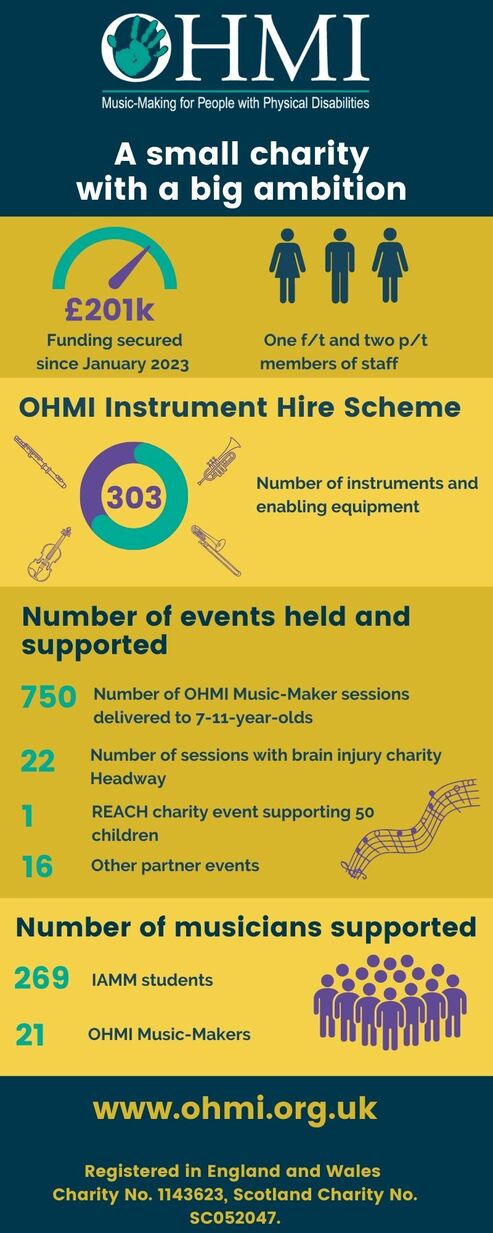 There has never been a more important time to support small charities. That's why we're supporting #SmallCharityWeek, taking place 19th - 23rd June. We often describe ourselves as a small charity with a big ambition. The above infographic serves to show that.
Despite the fact that OHMI only includes one full-time and two part-time members of staff, we are proud to run an Instrument Hire Scheme of some 303 instruments and enabling equipment, and lend our support to hundreds of events. Please do keep a look out on our social channels this week, and help spread the word about our work. #smallcharitiestogether. |
CategoriesArchives
April 2024
|
 RSS Feed
